A contemporary thangka is not itself a thousand years old. Its artistic and religious tradition, however, reaches back centuries.
Tibetan thangka painting developed across India, Nepal, Tibet, Kashmir, Central Asia, and China. Artists, teachers, monks, patrons, and sacred images carried ideas across the Himalayas.
The result was never a single, unchanging style. It was a living tradition shaped by exchange, adaptation, disruption, and renewal.
Today, Tibetan Buddhist painting continues in Tibet, Nepal, India, Bhutan, Ladakh, and communities worldwide. Kathmandu, especially Boudhanath, Patan, and Thamel, remains one important modern center.
This is the story of that continuing tradition.
Understanding the Origins of Thangka Painting
What Is a Thangka?
The word “thangka” usually describes a painted Buddhist scroll. It may also describe a Bon religious painting or another sacred Himalayan image.
A thangka is designed for viewing, teaching, meditation, ritual, or devotion. Its cloth support allows it to be rolled, transported, displayed, and stored.
You may also see the spellings “thanka” and “tangka.” These variations describe the same broad artistic tradition.
Traditional thangka painting often includes:
- Buddhist iconography and sacred symbolism.
- Carefully measured deity proportions.
- Portable cloth construction.
- Detailed religious painting.
- Gold, mineral, earth, or synthetic pigments.
- Silk brocade borders and protective coverings.
A thangka is more than decorative Himalayan art. It is a portable sacred image with religious, artistic, and cultural meaning.
A Complex Artistic Beginning of Thangka Painting
Thangka painting did not come from one single place. It developed within a much wider Buddhist artistic world.
Earlier Buddhist art from India provided important foundations. Nepalese paubha painting, Kashmiri art, Central Asian imagery, Chinese landscapes, and Tibetan religious practice shaped the tradition further.
A safer historical explanation is this:
Tibetan thangka painting developed within the Tibetan Buddhist world, drawing on earlier artistic traditions from India, Nepal, Kashmir, Central Asia, and China.
This history includes both influence and invention. Tibetan artists did not simply copy foreign models.
They adapted them for local beliefs, materials, landscapes, patrons, and religious communities.
Indian Buddhist Artistic Foundations
The Monasteries of Ancient India
Buddhist monasteries were important centers of learning and art. Nalanda, Odantapuri, and Vikramashila supported scholarship and religious culture.
These institutions flourished during different periods. They should all be placed within the fifth to seventh centuries.
- Nalanda expanded significantly from the fifth century onward.
- Odantapuri is usually associated with the seventh or eighth century.
- Vikramashila was founded during the late eighth or early ninth century.
Monasteries supported manuscripts, murals, sculptures, ritual objects, and portable sacred images. Many works have disappeared, but their influence traveled across Asia.
Early Buddhist Iconography
Indian Buddhist traditions developed detailed visual systems. These systems helped artists represent deities consistently.
They included:
- Body proportions
- Hand gestures
- Sacred attributes
- Facial expressions
- Deity colors
- Lotus arrangements
- Halo forms
- Symbolic ornaments
These systems were not frozen forever. Artists and religious communities adapted them across regions.
Indian Buddhist iconography later became central to Tibetan Buddhist painting. Tibetan artists also refined these systems through local teachings and workshop practice.
Portable Buddhist Images
Portable images served practical and religious purposes. They could travel with teachers, pilgrims, patrons, and monastic communities.
A portable Buddhist painting might support:
- Teaching complex religious ideas
- Meditation and visualization practices
- Ritual activities
- Devotional offerings
- Personal religious practice
- Display during travel
The portable format was practical across the Himalayan landscape. It could be rolled, carried, stored, and displayed when needed.
However, portability alone did not create the thangka. The format also developed through ritual use, iconography, patronage, and artistic exchange.
Buddhism Reaches Tibet
Royal Patronage and Early Buddhist Contact
Buddhism reached Tibet through several channels. These included trade, diplomacy, teachers, neighboring kingdoms, and royal patronage.
The Tibetan imperial court played a major role. During the seventh and eighth centuries, Buddhist institutions gained increasing political support.
King Songtsen Gampo is traditionally connected with early Buddhist temples. Tibetan accounts associate his reign with the Jokhang and Ramoche temples.
These histories also mention two Buddhist princesses:
- Princess Wencheng from the Tang court
- Princess Bhrikuti from Nepal
The historical details remain debated. Their importance is especially strong within Tibetan religious and cultural memory.
Trisong Detsen and Samye Monastery
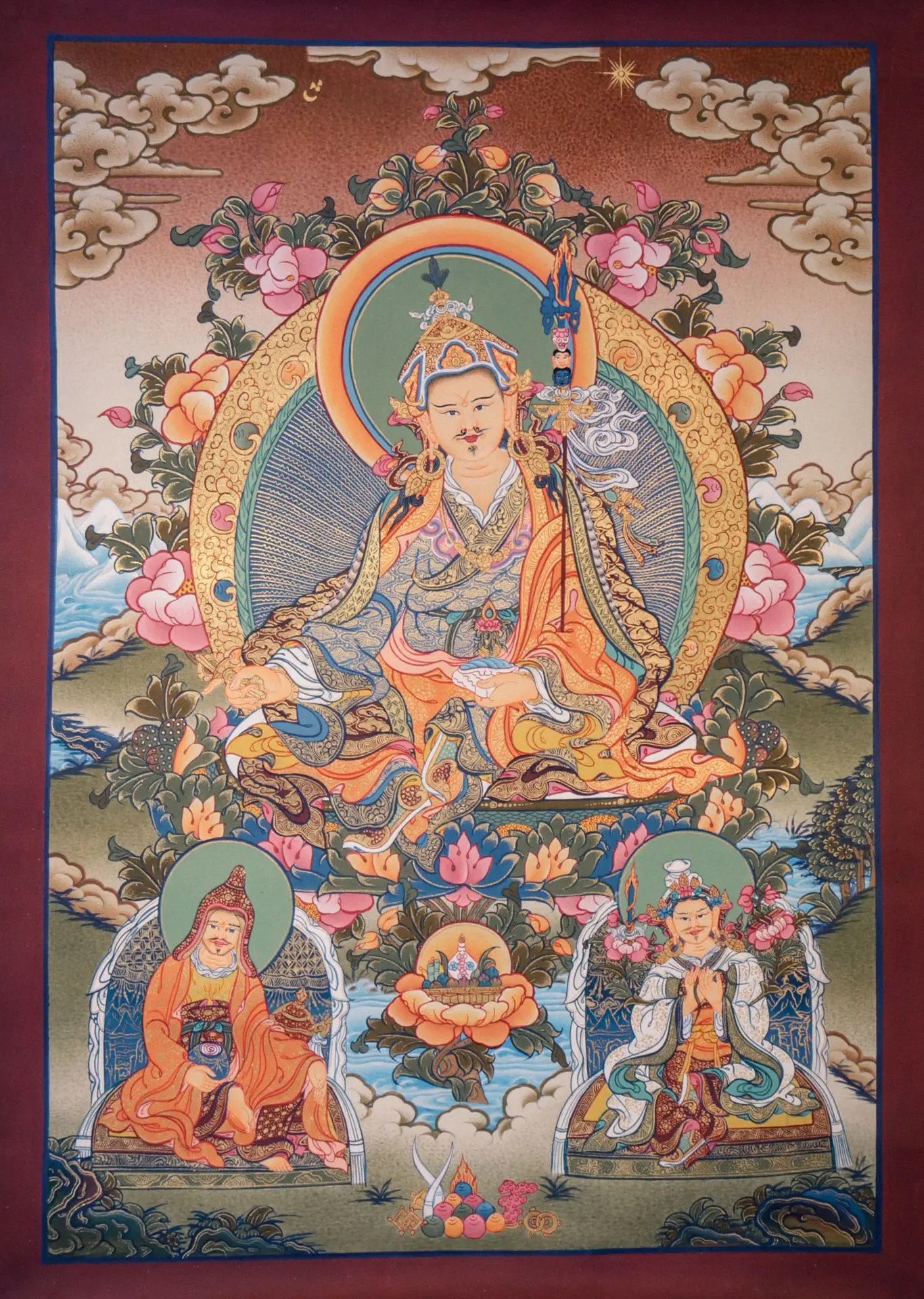
King Trisong Detsen greatly expanded Buddhist institutions. His reign supported translation projects, monastic construction, and artistic activity.
Samye is generally regarded as Tibet’s first Buddhist monastery. Its development involved Indian teachers, Tibetan translators, local artisans, and royal support.
Tibetan Buddhist tradition gives Padmasambhava an important role. The Indian abbot Śāntarakṣita also played a central part in the monastery’s early history.
This period connected Tibet with India and other Buddhist regions. It also encouraged the creation of murals, sculptures, manuscripts, and religious paintings.
Local Artists and Foreign Influences
Early Tibetan Buddhist art involved both local and foreign artists. Tibet already had strong craft, architectural, textile, and metalworking traditions.
Artists and specialists arrived from neighboring regions. They worked alongside Tibetan artisans and students.
Important influences included:
- Indian Buddhist iconography
- Kashmiri figure styles
- Nepalese painting methods
- Chinese landscapes and clouds
- Central Asian decorative forms
- Tibetan religious symbolism
Nepalese artists, especially Newar artists, later became highly influential. Their relationships with Tibetan patrons and monasteries continued for centuries.
The Tibetan Imperial Collapse
The Langdarma Narrative
Later Tibetan histories portray King Langdarma as hostile to Buddhism. They associate his reign with weakened monastic institutions and religious persecution.
Modern historians debate the scale of these events. They also question how later sectarian histories shaped the narrative.
The Tibetan Empire eventually fragmented. Centralized royal support for Buddhism weakened.
However, Buddhism did not disappear completely. Religious practices continued in regional communities and neighboring areas.
Regional Survival and Later Renewal
After the empire’s collapse, Buddhist activity became more regional. Some teachings and artistic traditions survived outside central Tibet.
From the late tenth and eleventh centuries, new teachers and translators arrived. This period is often called the Later Diffusion or Second Dissemination of Buddhism.
The period brought:
- New monasteries
- New translation projects
- Indian teachers
- Nepalese artistic exchange
- Fresh pilgrimage networks
- Renewed patronage
- Stronger artistic institutions
Tibetan artists did not rebuild everything from nothing. They combined surviving traditions with new religious and artistic transmissions.
The Great Flowering of Tibetan Buddhist Painting
Indian and Nepalese Connections
Tibetan monasteries commissioned artists from several regions. Nepalese and Newar painters became especially important partners.
Their work influenced:
- Figure proportions
- Decorative patterns
- Color relationships
- Gold application
- Facial features
- Composition
- Iconographic details
The relationship was not one-directional. Tibetan patrons, teachers, and artists also shaped Nepalese artistic production.
Artistic knowledge moved through:
- Apprenticeships
- Workshops
- Religious commissions
- Trade routes
- Family networks
- Teacher-student relationships
This exchange helped create what is now recognized as Tibetan Buddhist art.
Regional Tibetan Styles
Tibet covers an enormous geographic area. Different regions developed distinctive artistic combinations.
Central Tibet
Central Tibetan painting retained strong Indian and Nepalese influences. It also developed local approaches through monasteries, workshops, and religious patrons.
Western Tibet
Western Tibetan art shows important Kashmiri and Indian connections. Sites such as Alchi demonstrate the rich artistic exchange across the western Himalayas.
Eastern Tibet and Kham
Eastern Tibetan painting absorbed Chinese landscape traditions. Artists often used atmospheric backgrounds, distant mountains, decorative clouds, and spacious compositions.
These regional differences were never completely fixed. Artists, patrons, and religious communities continued to exchange ideas.
The Classical Tibetan Painting Schools
The Menri Tradition
Menla Dondrup and the Fifteenth Century
Menri is one of the best-known Tibetan painting traditions. It is traditionally associated with the fifteenth-century painter Menla Dondrup.
Some sources also connect him with the name Manthangpa. Biographical details vary, so exact locations and dates should be treated carefully.
Menri became highly influential in Tibetan painting. It was also important within Bon artistic traditions.
Menri is often associated with:
- Strong iconographic clarity
- Saturated colors
- Structured compositions
- Decorative detail
- Fine gold linework
- Clear visual hierarchy
- Chinese-influenced landscapes
These are broad tendencies, not strict rules. Individual artists and workshops interpreted Menri differently.
Menri became one of the most widely transmitted Tibetan painting traditions. Other regional and religious styles continued alongside it.
The Karma Gardri Tradition
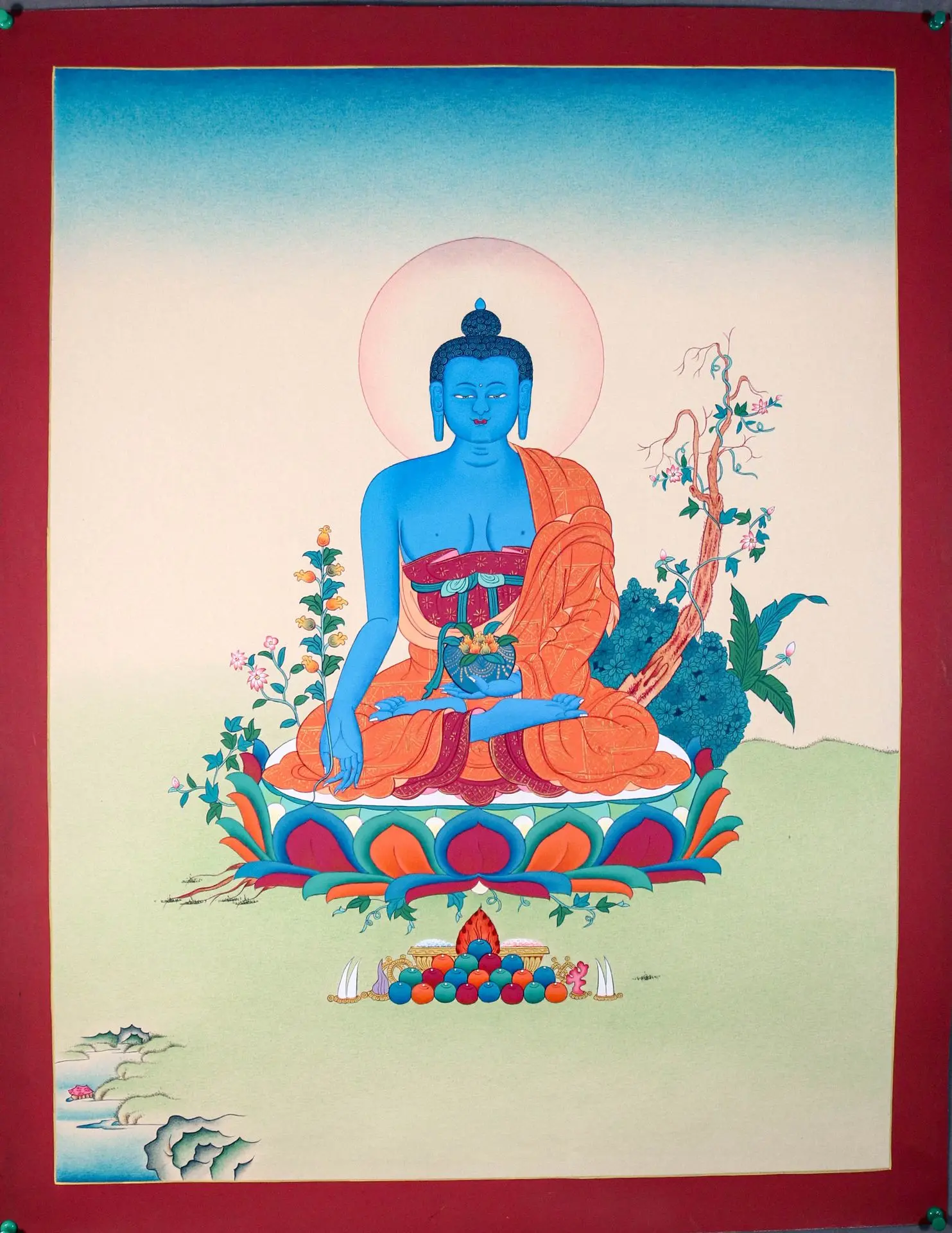
A Spacious Painting Language
Karma Gardri is also written Karma Gadri. It developed within the Karma Kagyu environment, especially in eastern Tibet.
The style is associated with artists such as Namkha Tashi. The Tenth Karmapa, Chöying Dorje, later became one of its most important practitioners and innovators.
Karma Gardri often features:
- Open compositions
- Atmospheric mountains
- Softer colors
- Landscape integration
- Spacious backgrounds
- Subtle transitions
- Contemplative visual qualities
Karma Gardri should not be reduced to one philosophical formula. Some scholars and practitioners interpret its open spaces through ideas of contemplation and emptiness.
That interpretation can be meaningful. It should not explain every painting universally.
Khyenri and Other Traditions
Khyenri is another important Tibetan painting tradition. It is associated with more naturalistic modeling and refined painterly qualities.
Artists also created regional variations of established styles. Their choices depended on lineage, monastery, patronage, region, subject, and personal training.
No single style represents all Tibetan thangka art. That diversity is one of its greatest strengths.
Traditional Thangka Materials
Mineral and Earth Pigments
Many traditional thangkas used mineral and earth pigments. Contemporary artists may also combine these materials with modern synthetic colors.
Traditional pigments included:
- Lapis lazuli for rich blues
- Azurite for lighter blues
- Malachite for greens
- Cinnabar for brilliant reds
- Orpiment for yellows
- Carbon black for deep black
- Chalk for white and ground preparation
Lapis lazuli was historically sourced from regions including Afghanistan. However, pigment origin cannot be assumed for every painting.
Artists prepared pigments through different processes. These could include grinding, washing, settling, levigation, drying, and binding.
The preparation time varied greatly. Some modern workshops purchase pigments already prepared.
Pigment Safety
Some traditional pigments contain toxic compounds. Cinnabar contains mercury sulfide, while orpiment contains arsenic sulfide.
These materials require professional handling. Readers should never grind unknown pigments without proper knowledge.
Natural Versus Synthetic Pigments
Mineral pigments can create distinctive surface depth. High-quality synthetic pigments can also offer excellent saturation, consistency, safety, and lightfastness.
The quality of a thangka depends on more than pigment type. It also depends on:
- Binder quality
- Canvas preparation
- Application technique
- Light exposure
- Humidity
- Storage
- Conservation history
No pigment lasts forever under every condition. Even mineral colors can fade, darken, or deteriorate.
The Tradition of Gold
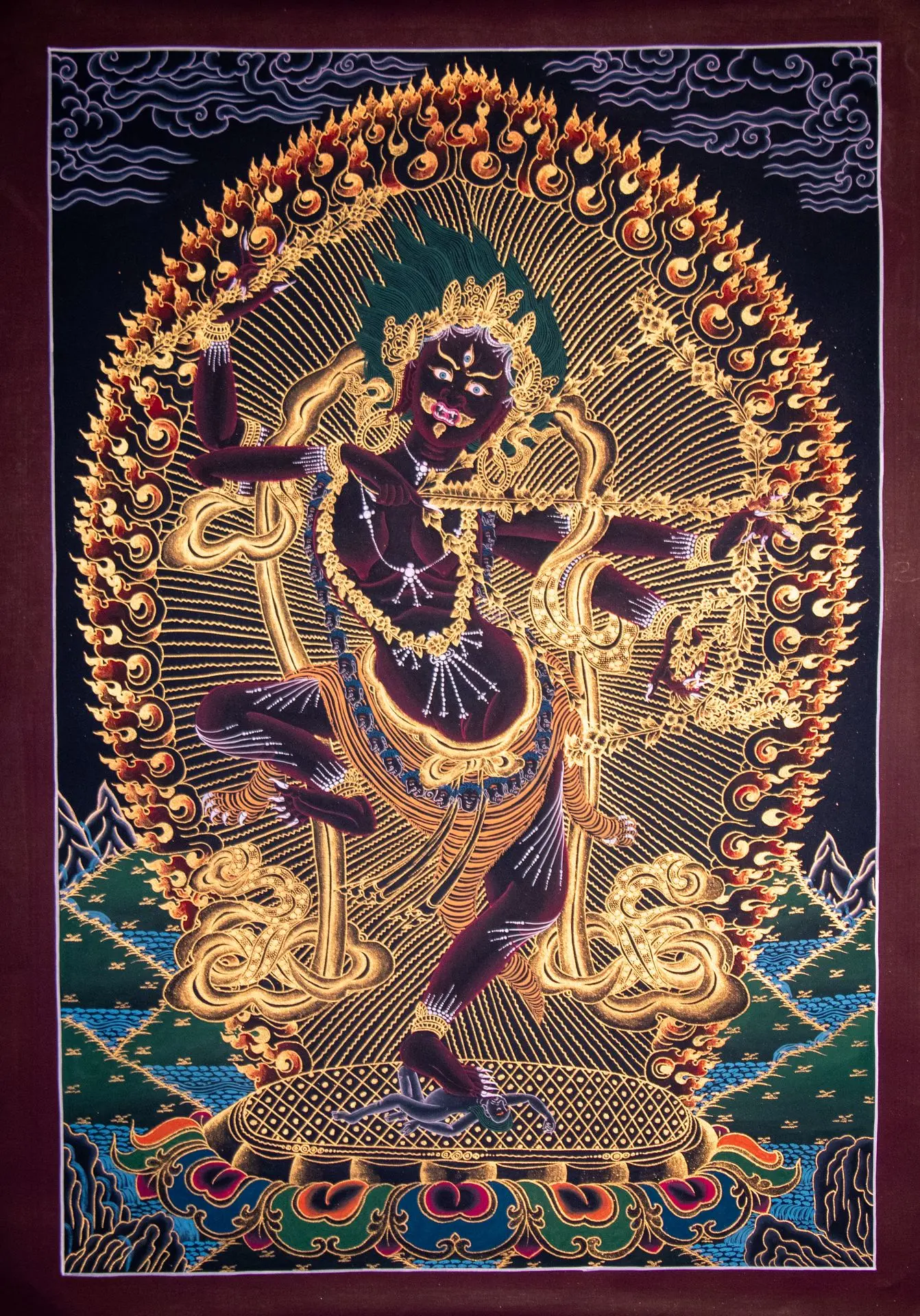
How Gold Appears in Thangka Painting
Gold can highlight important sacred details. Artists may use it for:
- Deity ornaments
- Halos
- Clothing
- Sacred outlines
- Jewelry
- Decorative patterns
- Gold-ground backgrounds
Traditional works may use genuine gold leaf, powdered gold, or shell gold. Contemporary works may also use imitation gold or metallic pigments.
The material should always be confirmed individually. A golden appearance does not automatically prove genuine gold.
Gold Application Methods
Gold leaf and powdered gold require different techniques. Artists may apply leaf directly or mix powdered gold with a traditional binder.
They may then burnish selected areas with a smooth tool. Some paintings receive repeated gold applications, while others use simpler techniques.
A gold-ground thangka is often called a serthang. The exact spelling and use may vary between sources and transliteration systems.
Preparing the Thangka Canvas
Traditional Canvas Preparation
Artists commonly begin with cotton cloth. Some thangkas use silk or other textile supports.
A traditional ground may include:
- Animal-hide glue
- Chalk or calcium-based filler
- Water
- Repeated smoothing
- Surface polishing
The cloth is stretched across a frame. Artists apply the ground in layers and smooth the surface.
A properly prepared canvas accepts paint evenly. It also remains flexible enough for careful rolling.
However, rolling is not risk-free. Humidity, heat, pressure, age, and repeated handling can cause damage.
Why Smell Is Not Reliable
Traditional materials may have a faint organic smell. That smell cannot authenticate a thangka.
Modern handmade paintings may use synthetic materials. Old paintings may also absorb smoke, mold, storage odors, or restoration chemicals.
Material authentication requires specialist examination. A conservator can assess pigments, canvas, binders, and construction more reliably.
Crisis, Exile, and Preservation
Political Upheaval After 1950
Chinese control over Tibet intensified during the 1950s. The 1959 uprising created a major political, religious, and cultural rupture.
The Dalai Lama fled to India in March 1959. Many Tibetans followed at different times, while others remained in Tibet.
The Cultural Revolution lasted from 1966 to 1976. During this period, religious institutions and artistic heritage suffered severe damage.
Large numbers of Buddhist artworks were:
- Destroyed
- Confiscated
- Damaged
- Dispersed
- Hidden
- Removed from monasteries
- Left without proper care
The exact number of destroyed thangkas remains difficult to establish. Specific figures should only be used with reliable archival sources.
Artists in Exile
Some artists, monks, and families escaped during the upheavals. Others left later or rebuilt their practices in new communities.
Some refugees preserved:
- Paintings
- Sketches
- Pattern books
- Brushes
- Tools
- Pigments
- Religious objects
Many artists carried little beyond their training and memories. Their knowledge became one of the most important forms of cultural preservation.
Artists and institutions established communities in:
- Dharamsala
- McLeod Ganj
- Kathmandu Valley
- Sikkim
- Ladakh
- Bhutan
- Tibetan settlements worldwide
Kathmandu and the Continuing Tradition
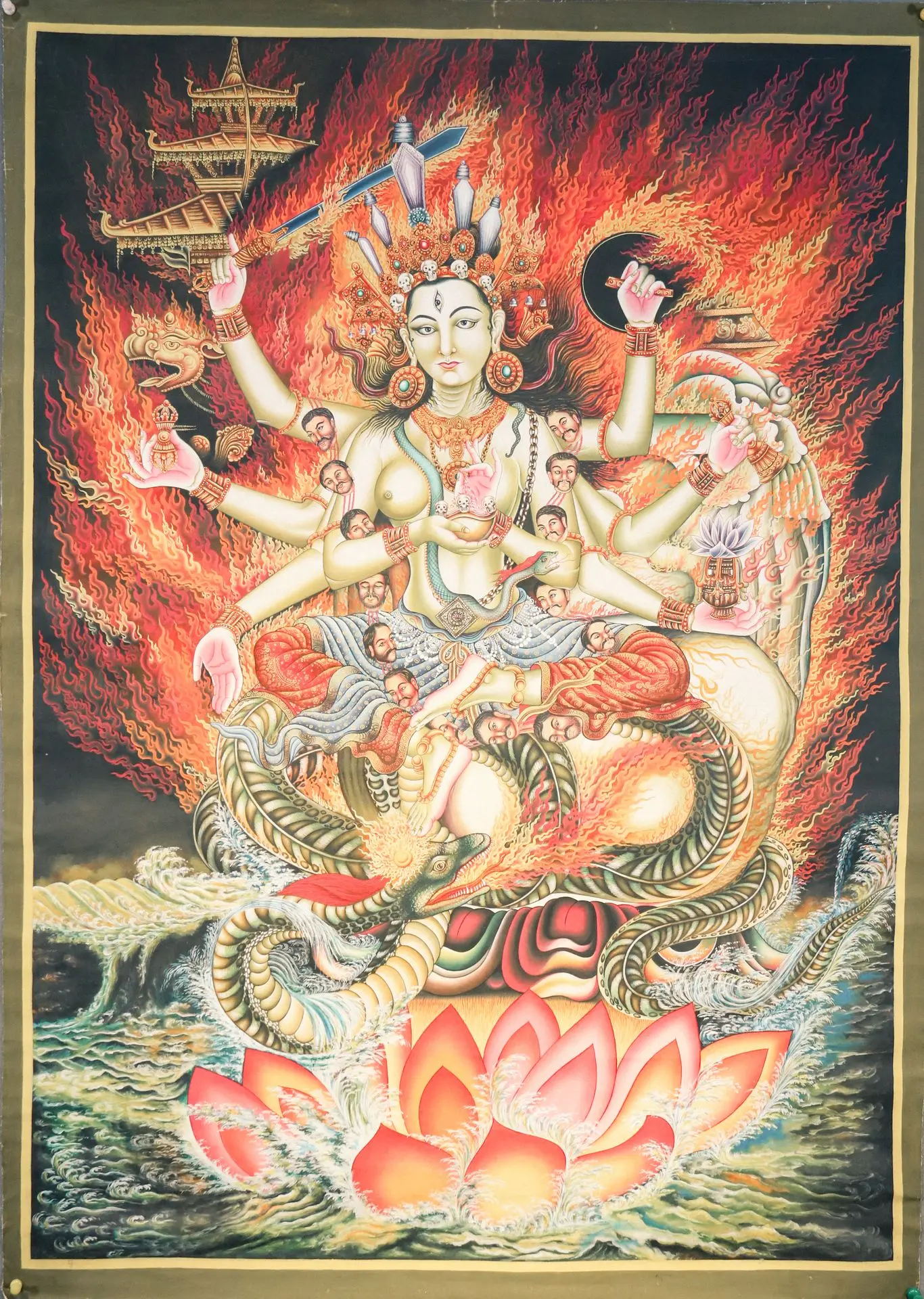
The Kathmandu Valley
Kathmandu already had a rich artistic culture. Newar artists had long practiced paubha painting and metal sculpture.
The valley also offered:
- Living Buddhist traditions
- Ancient monasteries
- Skilled artisans
- Regional trade networks
- Religious pilgrimage sites
- International visitors
- Access to artistic materials
These conditions supported Tibetan artists and refugee communities. They also encouraged collaboration between Tibetan and Newar workshops.
Boudhanath and Swayambhunath
Boudhanath became a major center of Tibetan Buddhist life. It remains important for monasteries, communities, religious practice, and Buddhist art.
Swayambhunath also connects Kathmandu’s Buddhist culture with sacred architecture and artistic traditions. Patan and other valley locations contribute significantly as well.
Thamel’s Commercial Role
Thamel became a prominent commercial and tourist district. Galleries and workshops there serve local customers, travelers, collectors, and international visitors.
However, Thamel is not the world’s only thangka center. It is one part of a wider Himalayan art network.
The tradition also continues in:
- Tibet
- Boudhanath
- Patan
- Dharamsala
- Bhutan
- Ladakh
- Sikkim
- Tibetan settlements
- Buddhist communities worldwide
Some artists preserve older family and teacher-student traditions. Others work across multiple styles and develop contemporary approaches.
How Thangka Artists Train Today
Learning Through Practice and Study
Thangka painting is learned through more than books. Training combines instruction, practice, texts, manuals, and observation.
A student may study:
- Canvas preparation
- Color mixing
- Borders
- Basic drawing
- Proportional systems
- Deity identification
- Attributes and gestures
- Figure construction
- Gold application
- Facial details
- Complex compositions
The sequence varies between teachers and institutions. There is no universal eight-year training system.
Some students begin producing simpler works earlier. Advanced iconography and complex compositions require much longer study.
Mastery may take decades. It depends on the artist’s teacher, discipline, opportunities, and specialization.
Pressures Facing Contemporary Artists
Traditional artists face changing economic conditions. Their challenges include:
- Inexpensive digital prints
- Factory-made paintings
- Rising material costs
- Customer price expectations
- Shorter production deadlines
- Fewer long-term apprentices
- Changing career preferences
Mass-produced works come from several production centers. The issue is not limited to one country.
Some younger people choose different careers. This can make long apprenticeships harder to sustain.
How Preservation Continues
The tradition remains active, though challenges continue. Preservation happens through both religious institutions and commercial workshops.
Important preservation efforts include:
- Family workshops
- Monastery training
- Artist apprenticeships
- Museum documentation
- Conservation projects
- International patronage
- Scholarly research
- Responsible collecting
Informed buyers can also help. Their choices influence which artistic practices remain economically possible.
When buyers choose authentic hand-painted work, they may support:
- Artists and their families
- Traditional workshops
- Long-term training
- Cultural documentation
- Responsible materials
- Future apprentices
This is an ethical position, not a guarantee. Every seller should still provide honest, verifiable information.
Tibet House Thanka’s Place in This Story
Tibet House Thanka operates in Thamel, Kathmandu. The gallery’s location provides access to artists, workshops, materials, and the valley’s wider Buddhist culture.
The gallery should describe each artwork accurately. That includes its artist, style, materials, size, mounting, and production history.
A responsible gallery can provide:
- Artist names
- Training backgrounds
- Workshop information
- Material descriptions
- High-resolution photographs
- Gold-use details
- Certificates or documentation
- Clear return policies
Claims about lineage should be documented individually. A tradition may be centuries old without every artist having a traceable ancient family line.
Likewise, “hand-painted” does not automatically mean “made entirely with natural pigments.” Each work should be described according to its actual materials.
Some thangkas may be taken to qualified Buddhist practitioners for consecration. This depends on the owner’s wishes, religious context, and local arrangements.
A transparent gallery should distinguish clearly between:
- Historical fact
- Traditional religious belief
- Artistic interpretation
- Artist biography
- Business claims
- Poetic storytelling
That honesty strengthens the meaning of the artwork.
Why This History Still Matters
A contemporary thangka is a new artwork. Its tradition, however, reaches through many generations.
It reflects:
- Indian Buddhist iconography
- Nepalese paubha painting
- Tibetan religious practice
- Himalayan artistic exchange
- Chinese landscape influence
- Monastic education
- Workshop knowledge
- Exile and cultural survival
The history is not a perfectly unbroken line. It includes loss, reconstruction, migration, and change.
That complexity makes the tradition more human. Artists preserved what they could, adapted when necessary, and taught others whenever possible.
Today’s painters continue that work differently. Some follow established styles closely, while others combine traditional methods with contemporary materials and audiences.
The tradition survives because people keep practicing it. Artists, teachers, monasteries, galleries, collectors, and communities all participate.
You Are Part of the Continuing Story
Buying a thangka is not the same as owning an ancient object. A modern painting should be described honestly as a contemporary work shaped by an old tradition.
That distinction does not make it less meaningful. It makes its real history easier to understand.
When you buy responsibly, ask questions. Learn about the artist, materials, style, and religious subject.
You may discover:
- A family workshop
- A monastery-trained painter
- A Newar artistic connection
- A Menri or Karma Gardri influence
- A contemporary interpretation
- A carefully documented creative process
Many artists learn through chains of teaching. Those chains connect present-day workshops with earlier Tibetan, Nepalese, Indian, and Himalayan traditions.
The tradition continues through adaptation. It continues through careful practice and informed support.
A thangka on your wall can represent that history. It can connect your home with a living artistic tradition.
Visit Tibet House Thanka in Thamel, Kathmandu. Meet artists, explore different Tibetan painting schools, and learn how contemporary works continue this remarkable Himalayan tradition.